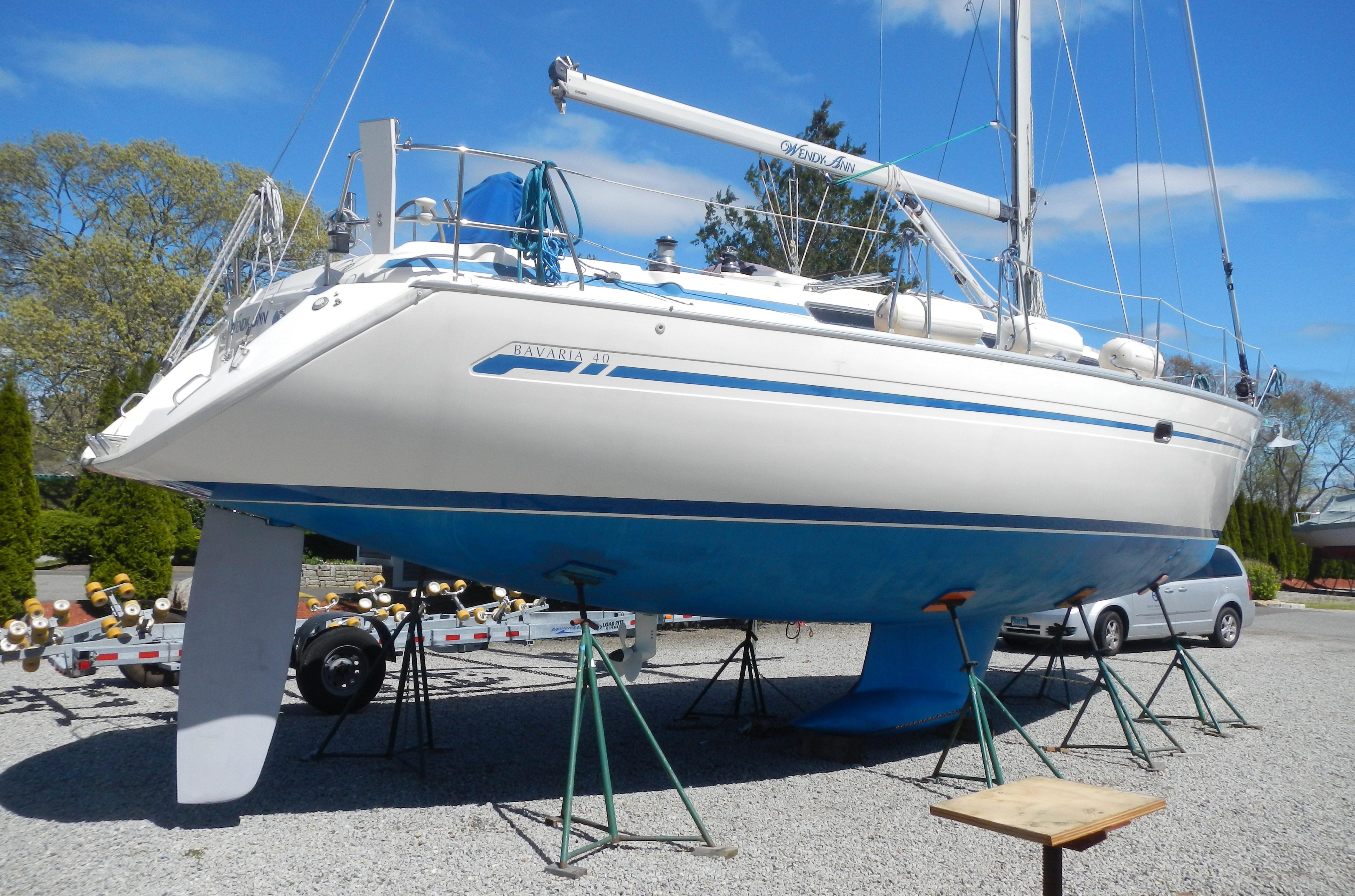


I’ve been so anxious to begin my future adventure on the sailboat, I have been almost non-stop in making preparations for that reality. After watching the boat being safely removed from the truck’s trailer last week and secured on jack stands, I returned on Saturday morning feeling slightly overwhelmed with everything I needed to do. That daunting thought was quickly erased when I remembered my dad’s advice whenever a job seemed to big for any one person.
He’d ask “How do you eat an elephant?” Answer: “One bite at a time!”
I secured my ladder to the stern of the boat and climbed aboard. I decided that my first “bite” would be to clean the teak surface of the decking that runs from bow to stern on both sides of the boat. Not wanting to cause any damage to the smooth wood surface, I added Dawn Dish Soap to a bucket of water and began scrubbing the teak with a long handled scrub brush. It was immediately apparent that this was working very well as the black dirt from 8 months of inactivity was being removed in the suds. I hosed down the first section I’d cleaned, then scrubbed it a second time, still noticing the somewhat dirty suds, but not as filthy as the first time.
When I began scrubbing the teak, I had created a schedule in my mind of how long each task would take and how many of those jobs I could complete in one day. It went something like this: Clean the teak in two hours, then stain it in another two hours. Scrub down the hull below waterline then sand it in preparation for the anti-fouling paint I would apply with a roller brush. This might take up to four hours. THEN, if all goes as planned, I might be able to paint part or all of the hull before the sun goes down. After all, it was June 24th and the longest day of the year had occurred just three days ago. I ought to have plenty of daylight.
THAT was my actual “plan”…in my head. It was NOT how the plan actually became reality. By 2:00 PM, I had finally finished cleaning all the teak decking and took a lunch break. Those first five hours were supposed to have been ample time to both clean it and stain it. I could not have underestimated the length of time each job would require by a larger margin.
The previous owners of the boat gave me a box with “paint supplies” which contained a quart of deck stain. It was such a small can, I had no idea how much surface area it would cover. But as long as I had it, I might as well begin using to see how far it would go. I’d never stained teak before so I was surprised to discover how watery the stain was. I literally felt like I was brushing water onto the surface even though the “water” had a brownish color. I noticed how quickly the teak absorbed the stain as if it was thirsty but I avoided the urge to apply two coats immediately. I wanted to see whether this one small can could stain the entire deck area.
To my surprise, it did, and the results looked beautiful. And I still had a tiny bit of stain remaining in the can, so I returned to the bow and applied a second coat to the triangular surface of the anchor well lid. The improvement in its appearance was night and day. A moment earlier, I thought all the teak looked perfect. But with the second application of stain to the lid, I knew I’d have to buy another can and put a second coat on the rest of the teak surface.
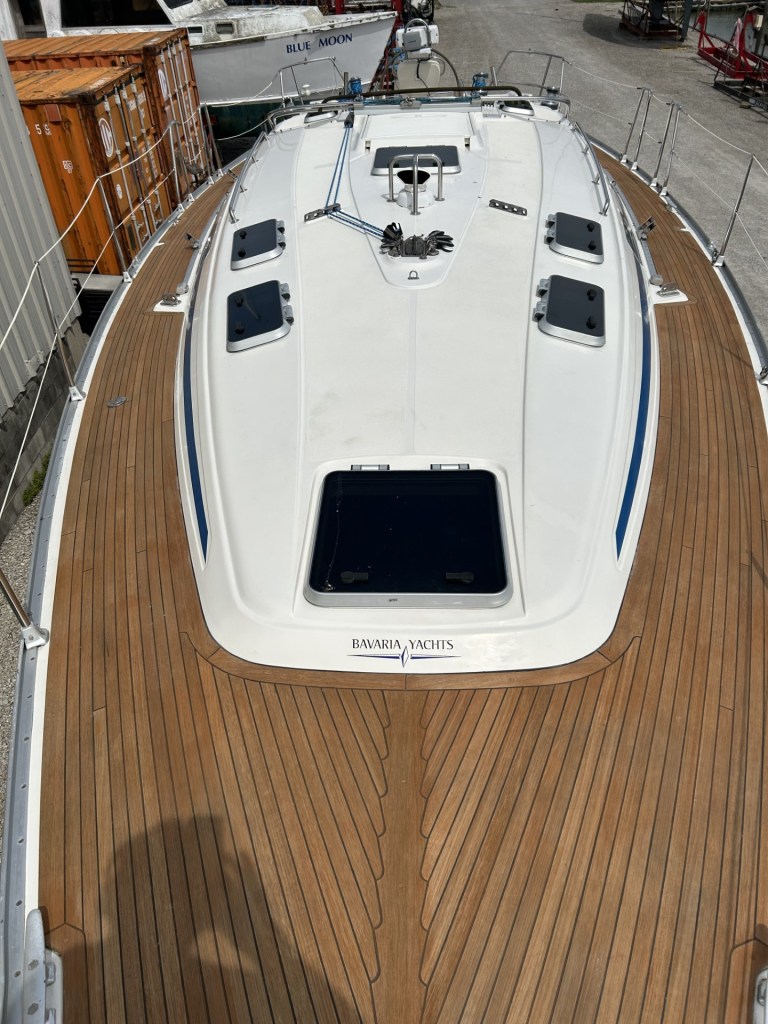
It was now well past 7:00 and even though I’d spent 10 hours on just the upper deck of the boat, I was more than satisfied with the result. I also understood that this elephant was going to take a really long time to eat.
The following day, I purchased an electric sander and returned to the boat to sand the entire hull below the waterline. This was an important first step to do two things: 1) erase the green scum line which had stained the boat from the previous boating season, and 2) to rough up the surface, allowing the paint to easily attach.
The electric sander was a good idea. Using it without a full body suit and face mask helmet was not. As I sanded the hull up and down, blue dust was flying everywhere like a blue cloud. I tried to work upwind from the sander, allowing that dust to blow away from me, but didn’t succeed very well. After 30 minutes and my eyes beginning to sting, I went to the restroom to clean my face.
What I saw in the mirror blew my mind. Staring back at me was a member of the Blue Man Group from Las Vegas. Not only had the blue dust gotten into my eyes, my entire head–hair, face, neck was completely blue with no flesh-tones anywhere! This was a BAD idea. I cleaned up my face as well as I could…which only changed the shade of blue to a dull greyish-blue and not bold royal blue color. But at least I could see again.
I returned to the boat, determined to use the breeze to my advantage and to a large extent I succeeded. The afternoon breezes had slightly strengthened, pushing the dust away from me instead of becoming a cloud around me. Another member of the marina noticed me and returned moments later with a face mask in hand, offering it to me as the obvious item I should have had all along. I was beyond grateful for his thoughtfulness and for the first time, I regretted throwing away all the face masks that had been in my car for the past three years.
I continued sanding, but like the work on the teak deck, this job too took the entire work day. The paint would have to be postponed to another day. My Saturday and Sunday were well spent, but the continued work would now have to occur after 5:00PM starting on Monday.
There was rain in the forecast for Monday, which meant no painting for me that day. But no such weather problems were in the reports for Tuesday. I arrived at 6:00PM and began very carefully applying blue tape to the top edge of the blue hull. I wanted to do this as accurately as possible so that the finished product would look good. I wore my reading glasses for this up-close work to make sure every inch of the tape was precisely where it needed to be. The mere act of taping the edge of the painted hull took over an hour. I probably shouldn’t have been surprised but once again, I was.
As I rolled on the thick blue paint, I immediately was impressed at how thoroughly it covered the surface and how beautiful it was. The instructions told me to keep stirring the paint every couple minutes, but that would have required an extra set of hands. I was busy dipping the roller in the pan and saturating the brush with blue paint, watching the hull transformed from a dirty appearance to showroom-perfect.
After painting the hull, I asked the marina staff if they could reposition the jack stands to allow me to paint those 12″ squares that had not yet been painted. Apparently, that’s not their protocol. The day we launch the boat and reattach the mast and rigging, they will pick the boat up on the lift around 11:00 AM and position the boat near the water by 11:30. At that time, the crew goes to lunch for one hour and that brief window will allow me to get beneath the boat and paint every space that had been supporting the boat on land, including the bottom of the keel. If I work quickly, I hope the paint will be dry enough to go into the water at 12:30 when the crew returns.
Last night, I decided to begin waxing the gelcoat topsides of the boat. I bought a fiberglass wax that was in a liquid form and new 10″ soft pads for my electric buffer. The bottle of wax read “Apply to surface with a damp cloth. When it dries to a light haze, remove with a clean cloth or buffer.” Easy enough. I waxed the bow, moving in small sections from left to right. After applying the wax to about 12′ of the surface, the first 4′ now looked dry enough to buff. I ran the buffer up and down along the side of the hull then stepped off the ladder to see how it appeared from an angle.
Uhgh. I seemed to only smear the dried wax in funky patterns, not a clean, shiny gloss. I climbed back up on the ladder and buffed it again, trying to do longer up and down movements to prevent those patterns of wax dust residue. Still no good. I tried buffing a third time and rationalized that THIS time I was satisfied with the results…when I knew I was lying to myself. I wondered whether I’d allowed the dried wax to remain on the surface too long, so I re-waxed the original section and stood back and watched until it appeared dry enough to buff off. Finally, this time it did look nice, but another 8′ of the hull that I’d waxed many minutes ago was now SO dry, it would not buff. I tried to re-wax a 3′ section at a time, wait for it to dry, then use the buffer. Mediocre result at best. I did this for about 12′ of the 40′ length of the boat and realized I’m using the wrong wax. It was not coming off easily nor was it creating a uniform glossy appearance. We’ll have to try again, but this time using a traditional paste wax that I’m more familiar with.
Many people have stopped by to meet me and say hello, which is very welcoming in the sailing community, and most of them admit that my boat is exceptionally beautiful. Almost nobody can believe it is a 2001 yacht due to its overall condition. We’re in full agreement that the previous owners took very good care of it and maintained it better than other boat owners. I’m determined to continue that tradition. I hope my next choice of wax proves to have better results than the first product. I’ll have the upcoming weekend to find out.
 Cool Change Sailing
Leave a comment